
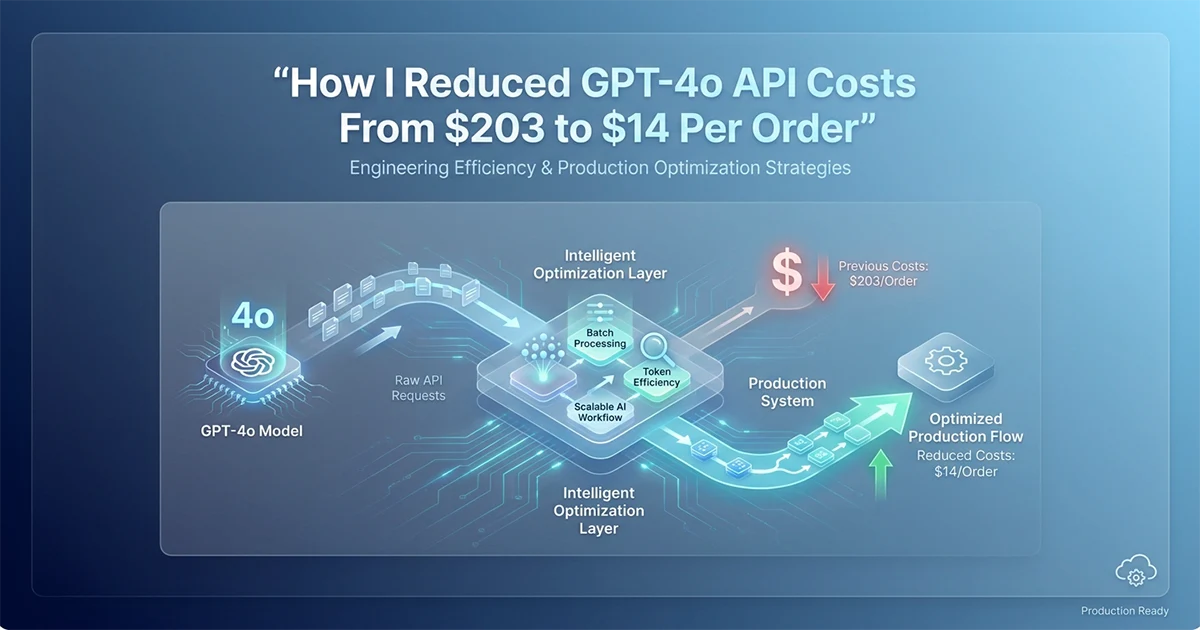
The $203 First Run: Four Mistakes That Made One Order Cost a Month's Salary
The $203 order came from four compounding mistakes: no token budgets, oversized batches causing retries, no pre-computation, and no rate limit protection — each roughly doubling or tripling cost unnecessarily.
See also: GPT-4o vs Gemini Flash cost comparison.
I built an AI report generation SaaS where the largest product makes 161 GPT-4o API calls per order, generating 8,620 individual AI answers assembled into a ~1,725-page PDF. The first test run cost ~$203. Production runs ~$14 for the same optimized tier — though the full-scale product now lands at $15–25 with current token budgets. Same model. Same gpt-4o. Same final answer count. I did not switch to gpt-4o-mini or reduce output quality. I fixed four configuration mistakes that turned a month's salary into a line item I could price into the product margin.
The pipeline runs on a Celery worker triggered by Stripe payment — AI generation completes before PDF assembly begins. Cost optimization happened entirely in the generation layer: how many tokens each call produces, how many items each batch contains, what data enters the prompt, and how fast calls fire. None of the four fixes required rewriting the product. They required measuring what the API was actually doing and stopping it from doing work I never asked for.
Four problems stacked on each other:
- No token budgets: GPT-4o defaulted to 500–800 tokens per answer when the product needed 80–150 words (~100–200 tokens). Wasted tokens: 3–5× on every call. 161 calls × 3–5× waste ≈ ~$80 of avoidable spend.
- Oversized batches: Five days per batch compressed answers to 20–30 words by item four. Word count validation failed → retry → duplicate cost. ~15% failure rate × multiple retries ≈ ~$60 wasted.
- No pre-computation: The model reasoned through domain calculations a Python library handles in milliseconds. ~15% of prompt tokens wasted ≈ ~$30.
- No inter-batch sleep: 429 rate limit errors from call 50–80 onward. Each retry cost the same tokens as the original call ≈ ~$30 wasted.
Total wastage: ~$189 on top of ~$14 of actual useful work. Optimizing a GPT-4o application is mostly about eliminating waste, not reducing the core work.
| Optimization | Root cause | Approx. saving | Implementation effort |
|---|---|---|---|
| Token budgets | Unbounded max_tokens → 3–5× token waste | ~$80/order | 30 min — add max_tokens to every API call |
| Smaller batch sizes | Large batches → word compression → retries | ~$60/order | 1 hour — tune batch size empirically |
| Pre-computation + caching | AI computing deterministic data | ~$30/order | 2–4 hours — extract + cache domain calculations |
| Inter-batch sleep | 429 errors → automatic retries | ~$30/order | 5 min — add asyncio.sleep(2.0) |
| Total saving | — | ~$189/order | ~1 day total |
The API cost for the useful output alone was ~$14. Everything above that was waste. Optimizing a GPT-4o application is mostly about eliminating waste, not reducing the core work. When I opened that first $203 invoice, I panicked — then realized $189 of it was configuration mistakes I could fix in a day, not a fundamental problem with the product.
Optimization 1: Token Budgets — The $80 Fix That Takes 30 Minutes
Setting explicit max_tokens based on real output analysis cut per-order costs by ~60% — GPT-4o without max_tokens defaults to generating 3–5× more tokens than the application actually needs. This is the highest-impact step in any reduce GPT-4o API cost production optimization 2026 workflow.
How to calculate the right max_tokens
Formula: target_words × 1.3 tokens/word × items_per_batch × 1.2 safety. The 1.3 multiplier converts English words to tokens (≈0.75 tokens per word inverted). The 1.2 safety allows answers to run slightly long without hard cutoff mid-sentence.
Example: 3 days × 20 questions × 150 words × 1.3 × 1.2 ≈ 14,040 → round down to TOKEN_BUDGET_DAILY = 12,000.
# app/services/ai/token_budgets.py

import structlog
from openai import AsyncOpenAI

logger = structlog.get_logger()

# Derived from: days_per_batch × questions_per_period × target_words × token_ratio × safety_margin
TOKEN_BUDGET_DAILY = 12_000    # 3 days × 20Q × 150 words × 1.3 × 1.3 ≈ 11,700
TOKEN_BUDGET_WEEKLY = 8_000    # 2 weeks × 20Q × 100 words × 1.3 × 1.5 ≈ 7,800
TOKEN_BUDGET_MONTHLY = 8_500   # 1 month × 20Q × 150 words × 1.3 × 1.3 + margin
TOKEN_BUDGET_YEARLY = 4_000    # 1 year overview × 20Q × 80 words × 1.3 × 1.5


def log_token_usage(response, batch_type: str) -> None:
    usage = response.usage
    logger.info(
        "token_usage",
        batch_type=batch_type,
        prompt_tokens=usage.prompt_tokens,
        completion_tokens=usage.completion_tokens,
        total_tokens=usage.total_tokens,
    )


async def generate_daily_batch(
    client: AsyncOpenAI,
    system_prompt: str,
    batch_prompt: str,
) -> str:
    response = await client.chat.completions.create(
        model="gpt-4o",
        messages=[
            {"role": "system", "content": system_prompt},
            {"role": "user", "content": batch_prompt},
        ],
        max_tokens=TOKEN_BUDGET_DAILY,  # hard cap — prevent runaway generation
        temperature=0.8,
        timeout=180.0,
    )
    log_token_usage(response, "daily")
    return response.choices[0].message.content
Analyzing real output to set budgets
I ran ten test orders and logged actual token usage per batch type via log_token_usage(). For each batch type, I set max_tokens to 120% of the 90th percentile actual completion tokens — enough room for longer answers without paying for runaway generation. The first version had no cap; GPT-4o wrote novels when I needed paragraphs. After budgets, per-call output tokens dropped ~60% with no quality regression on word count validation.
The budgets are not guesses. TOKEN_BUDGET_DAILY = 12,000 came from measuring 3 days × 20 questions × ~150 words × 1.3 token ratio, then rounding down with margin. TOKEN_BUDGET_WEEKLY = 8,000 and TOKEN_BUDGET_MONTHLY = 8,500 follow the same derivation per batch type. If you set max_tokens too low, answers truncate mid-sentence and validation fails — triggering retries that cost more than the extra tokens would have. The goal is a hard ceiling, not a target.
Optimization 2: Smaller Batches, More Calls, Lower Cost (The Counterintuitive Fix)
Reducing items per API call from 5 days to 3 days increased the total call count by 49 but lowered total cost because it eliminated the word-count failures that were causing expensive retries.
Why large batches cause compressed answers
With five items per batch, GPT-4o allocates attention and token budget across all five. By items four and five, answers compress to 20–30 words instead of the required 80–150. Word count validation fails. The batch retries at full batch cost — same tokens, same price, zero new value.
The math on daily sections:
- BEFORE (5 days/batch): 122 batches. ~15% failure rate = ~18 retried batches. 18 retries × 5 items × ~$0.08/batch ≈ ~$7.20 in retry waste.
- AFTER (3 days/batch): 171 batches (+49 calls). <2% failure rate = ~3 retried batches. 3 retries × 3 items × ~$0.07/batch ≈ ~$0.63 in retry waste.
- Net: +49 calls × ~$0.07 = +$3.43 in extra calls. −$6.57 in eliminated retries. = −$3.14 net saving per order, plus quality improvement.
Monthly sections followed the same pattern: two months per batch → one month per batch added six API calls (~3 minutes runtime) but eliminated compressed 20–30 word answers for months 11–12. Six retried batches × five items × three retry attempts cost more than forty-nine extra calls. This is the counterintuitive insight most developers miss: API call count is the wrong metric. Total cost = (successful calls × per-call price) + (failed batches × retry multiplier × per-call price). Optimizing call count alone can increase total spend if failure rate rises.
Validation-driven retries remain the safety net. Tenacity handles exponential backoff at 4–60 seconds with three max retries. Word count validation catches genuine quality failures — Blueprint min 180 words, Horoscope 80–150 words hard max 160. With proper batch sizes and token budgets, validation failures dropped from ~15% of batches in the first version to under 2% in production. Each prevented retry saves a full batch cost at gpt-4o output pricing.
How to find your optimal batch size
No formula — empirical process. Test 1, 3, 5, 7 items per batch. Measure validation failure rate and total cost (calls + retries). The optimal size is where failure rate drops below ~2% and total cost is minimized. I track failure rate in structlog, not just call count.
Track your validation failure rate, not just your API call count. A 5% validation failure rate is expensive — every failure doubles the cost of that batch. Smaller batches with higher per-call cost but lower failure rate are almost always cheaper at scale. Blueprint sections use min 180 words per answer; horoscope sections require 80–150 words with a hard max of 160.
Optimization 3: Pre-Compute What the AI Doesn't Need to Reason About
Every token you spend asking GPT-4o to compute something a deterministic library can calculate for free is a token wasted — pre-compute all domain-specific data and inject it as structured context.
What was being computed vs what should have been pre-computed
The initial implementation included raw input data that required the model to perform domain calculations in its reasoning. The optimized version pre-computes natal chart positions, daily transit data (Moon sign, Moon phase, Sun sign, aspects) for 365 days using a Python astronomy library, stores results in Redis with an 86,400-second TTL (24 hours), and injects structured values directly into each prompt. AI prompt tokens dropped ~15% because the model receives data, not problems to solve.
Per-day transit info caches in Redis so repeated batch calls for the same report date hit warm cache instead of recomputing. The compute function runs once per user per report date; all 161 subsequent API calls read the same structured context. This pattern generalizes beyond my domain: any fact derivable from input parameters without generative reasoning belongs in pre-computation, not in the prompt as an instruction for the model to figure out.
# app/services/domain/context_cache.py

import json
import redis
from typing import Any, Callable, Awaitable

CACHE_TTL = 86_400  # 24 hours


async def get_or_compute_context(
    cache_key: str,
    compute_fn: Callable[[], Awaitable[dict[str, Any]]],
    redis_client: redis.Redis,
) -> dict[str, Any]:
    cached = redis_client.get(cache_key)
    if cached:
        return json.loads(cached)

    context = await compute_fn()
    redis_client.setex(cache_key, CACHE_TTL, json.dumps(context))
    return context


async def build_batch_prompt(
    batch_spec: dict,
    user_id: str,
    report_date: str,
    redis_client: redis.Redis,
) -> str:
    context = await get_or_compute_context(
        cache_key=f"context:{user_id}:{report_date}",
        compute_fn=lambda: compute_domain_data(batch_spec["user_params"]),
        redis_client=redis_client,
    )
    # Inject pre-computed context — model synthesizes narrative, not math
    return render_prompt_template(batch_spec, injected_context=context)
What the AI should and shouldn't compute
AI should: generate narrative, synthesize patterns, write varied prose across 8,620 answers with consistent voice. AI should NOT: perform deterministic calculations, format data you already have, or reason about domain facts a library resolves in milliseconds. The test: "Could this be answered by a lookup table or formula?" → pre-compute it.
Don't over-pre-compute. If the domain knowledge genuinely requires contextual synthesis — connecting multiple facts in a human way — the AI earns its cost. Pre-computing means running deterministic operations, not removing nuanced reasoning. Transit positions are lookup data; interpreting how three transits interact in a customer's life narrative is synthesis work worth paying for.
Optimization 4: Sleep Between Batches (the $30 Fix That Takes One Line)
Adding 2 seconds of sleep between API batches eliminated nearly all 429 rate-limit errors — and each prevented 429 saves the cost of an entire batch retry.
The compounding cost of 429 errors
Without sleep, sequential calls hit OpenAI's rate limiter around call 50–80 in a 161-call run. Each 429 triggers a tenacity retry with exponential backoff — wait 4s, wait 8s, wait 16s, then retry at full token cost. A single 429 at batch 80 means calls 80–161 are each retried at least once. Blueprint runs use INTER_BATCH_SLEEP = 1.5 seconds; the long horoscope pipeline uses 2.0 seconds. After adding sleep, 429 errors dropped to near-zero — the cheapest optimization in the entire stack for five minutes of implementation.
The batch runner persists each successful batch to MongoDB via upsert_batch() before sleeping — crash recovery and cost control share the same loop. A worker OOM during PDF assembly does not lose completed AI batches; retry resumes from the last checkpoint. That persistence pattern pairs with the Celery architecture I documented in my FastAPI + Celery production guide on hassanr.com.
# app/services/ai/batch_runner.py

import asyncio
import openai
from openai import AsyncOpenAI

INTER_BATCH_SLEEP = 2.0   # prevents 429 rate limit errors in 161-call runs
MAX_RETRIES = 3


async def run_batch_manifest(
    client: AsyncOpenAI,
    session_id: str,
    batch_manifest: list[dict],
    repo,
) -> None:
    for batch_id, batch_spec in enumerate(batch_manifest):
        for attempt in range(MAX_RETRIES):
            try:
                response = await client.chat.completions.create(
                    model="gpt-4o",
                    messages=build_messages(batch_spec),
                    max_tokens=batch_spec["token_budget"],
                    temperature=0.8,
                    timeout=180.0,
                )
                answers = parse_and_validate(response, batch_spec)
                if not meets_word_count(answers, min_words=80):
                    raise ValueError("Answers too short — retry with same batch")

                await repo.upsert_batch(session_id, batch_id, answers)
                break

            except openai.RateLimitError:
                wait = 4 * (2 ** attempt)
                await asyncio.sleep(wait)

            except ValueError:
                continue  # word count failure — retry immediately, no sleep

        await asyncio.sleep(INTER_BATCH_SLEEP)
Calculating the right sleep duration
OpenAI rate limits are per-minute, not per-second. 2.0 seconds between calls = 30 calls/minute maximum — comfortable margin under most plan limits. Higher-tier plans with higher RPM can reduce to 1.0s. The sleep cost: 161 calls × 2.0s = 322 seconds of wait time. The retry cost prevented: ~$30 of batch retries. 322 seconds is cheap insurance.
Every 429 error is a paid retry. Sleep is free. For a 161-call run, 322 seconds of sleeping costs nothing. The retries it prevents cost real money — sometimes as much as the original run itself.
When to Use GPT-4o vs GPT-4o-mini: An Honest Guide
GPT-4o-mini costs ~6–8× less than GPT-4o — but for extended narrative generation with 8,620 answers requiring consistent voice and quality, gpt-4o-mini answers were too short and inconsistent to meet production requirements.
The cost difference at scale
gpt-4o: ~$15–25 per large report order in production. gpt-4o-mini: ~$2–4 per large report order in local testing. Potential saving: $13–21 per order if gpt-4o-mini is sufficient. I evaluated switching; the quality gap was too large for this product.
When each model is right
gpt-4o — extended narrative, 100+ word answers needed, consistent voice across hundreds of generations, nuanced synthesis of multiple data points. gpt-4o-mini — short structured output (JSON, lists, classification), single-question answers, data extraction, simple Q&A where length does not matter.
The evaluation test: run the same batch on both models. If gpt-4o-mini answers are consistently within word count range, tonally consistent across a full run, and factually accurate for your domain → switch and save 6–8×. One unused config note: OPENAI_MODEL exists in my settings but all runners hardcode gpt-4o directly — dead code I should clean up.
For simpler products on the same platform — fast reports with four parallel Agents SDK calls finishing in fifteen seconds — gpt-4o-mini may suffice. For the large report with 8,620 narrative answers requiring multi-paragraph coherence and consistent voice across a four-hour generation run, gpt-4o-mini answers were shorter, less specific, and drifted in tone by batch 80. Hassan Raza on hassanr.com helps clients run this evaluation before committing to a model tier — the wrong choice either wastes money or ships a product customers refund.
Frequently Asked Questions
Set max_tokens, tune batch size, pre-compute deterministic data, and add inter-batch sleep — in that order. Hassan Raza reduced an AI report SaaS from $203 to $14 per order with these four changes. Token budgets on every GPT-4o call were the biggest saving (~$80). Smaller batches eliminated word-count retries (~$60). Pre-computing domain data with Redis caching cut prompt tokens (~$30). Two-second inter-batch sleep stopped 429 retries (~$30). Total implementation time: approximately one day.
GPT-4o costs $2.50 per 1M input tokens and $10 per 1M output tokens at time of writing — check platform.openai.com for current pricing. At scale, cost per order depends on batch size and token budgets, not just call count. Hassan Raza's optimized 161-call pipeline runs $15–25 per order. Without optimization — no max_tokens, large batches, no pre-computation — the same pipeline cost $150–200+ per order. Configuration accounts for roughly 90% of cost; the code is straightforward.
Set max_tokens to 120% of measured 90th-percentile usage, keep batch failure rates under 2%, and pre-compute all deterministic data before any API call. Retries double batch cost — smaller batches with higher call counts often beat large batches with frequent failures. Hassan Raza runs 161 GPT-4o calls per large report order with explicit TOKEN_BUDGET_DAILY=12,000 caps. For cost-sensitive apps, evaluate gpt-4o-mini — 6–8× cheaper per token. Extended narrative generation with consistent voice across thousands of answers usually requires gpt-4o.