
What Actually Changed: The Real Numbers Behind Gemini 3.5 Flash
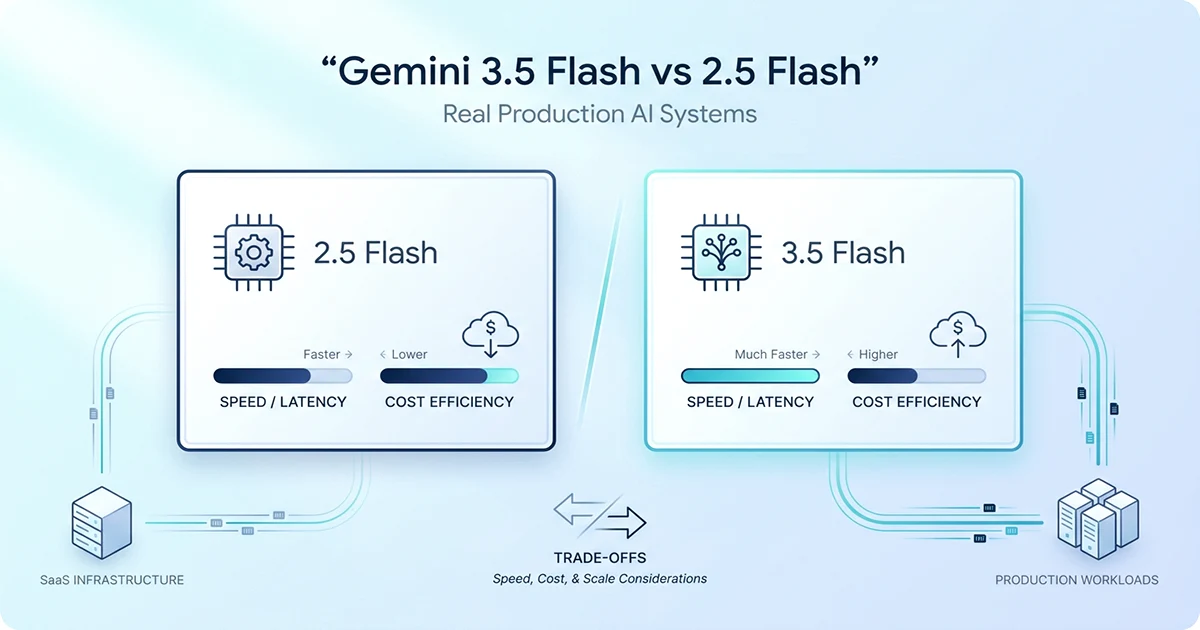
Gemini 3.5 Flash costs $1.50/$9.00 per million input/output tokens — 5× more expensive on input and 3.6× more on output than Gemini 2.5 Flash — while delivering roughly 20% faster output speed and meaningfully better agentic capability. That is the headline Google did not put on the I/O slide.
I watched the May 19, 2026 announcement with the same reflex most engineers had: update the model string, ship it, collect the benchmark win. Then I ran the numbers against my affiliate marketing SaaS — ten AI content tools on gemini-2.5-flash, all structured short-form generation via @ai-sdk/google and Zod schemas. The invoice math stopped me cold. This is not a free upgrade. It is a different product tier priced like one.
| Metric | Gemini 2.5 Flash | Gemini 3.5 Flash | Difference |
|---|---|---|---|
| Input (standard) | $0.30/1M tokens | $1.50/1M tokens | 5× more |
| Output (standard) | $2.50/1M tokens | $9.00/1M tokens | 3.6× more |
| Cached input | $0.15/1M tokens | $0.15/1M tokens | Same |
| Output speed | ~232 tokens/sec | ~278 tokens/sec | +20% |
| TTFT (no thinking) | ~1–3 seconds | ~2–5 seconds | Similar |
| TTFT (high thinking) | N/A | 17–19 seconds | New overhead |
| Context window | 1M tokens | 1M tokens | Same |
| Output cap | Not specified | 65,536 tokens | New limit |
| Dynamic thinking | No | Yes (default ON) | New cost variable |
Google's "4× faster" claim compares Gemini 3.5 Flash (~278 tokens/second) against frontier models like GPT-5.5 and Claude Opus 4.7 — not against Gemini 2.5 Flash at ~232 tokens/second. The actual gain over your current stack is about 20%, not 400%.
Both models support roughly 1M input tokens. Gemini 3.5 Flash adds a 65,536-token output cap — relevant for very long single responses, irrelevant for caption and ad-copy tools where outputs sit between 150 and 400 tokens. Model ID is gemini-3.5-flash (GA). Dynamic thinking is on by default, so token usage and latency stay unpredictable until you configure them explicitly.
On capability benchmarks, 3.5 Flash leads 3.1 Pro on Terminal-Bench 2.1 (76.2% vs 70.3%), MCP Atlas (83.6% vs 78.2%), and Finance Agent v2 (57.9% vs 43.0%). It trails 3.1 Pro on long-context MRCR v2 128K and Humanity's Last Exam. Faster output tokens do not mean faster products when thinking latency sits in front of the stream.
The Real Production Cost Math: What 10 AI Tools Actually Cost on Each Model
For a content generation SaaS with 10 AI tools running $20–60/month on Gemini 2.5 Flash, the same workload on Gemini 3.5 Flash costs approximately $100–300/month without caching — or $60–150/month with context caching enabled on system prompts. That range is not hypothetical; it is what falls out when you multiply per-call economics by real call volumes.
My affiliate marketing SaaS runs Instagram caption generators, YouTube script intros, Facebook ad copy, email subject lines, product descriptions, and five similar tools — all short-form structured output, all real-time UX where users watch a cursor blink. Monthly AI spend: $20–60 combined. Average output per call: 150–400 tokens. Users do not wait patiently for model introspection; they abandon. Cost is the binding constraint, not benchmark leaderboard position.
The content generation workload cost breakdown
Start with a representative call profile — not a benchmark trace, a production average:
- Average input: ~400 tokens (200-token system prompt + 200-token user input)
- Average output: ~300 tokens (ad copy, caption, script excerpt)
Per call on Gemini 2.5 Flash:
(400 × $0.30 / 1,000,000) + (300 × $2.50 / 1,000,000) = $0.000120 + $0.000750 = $0.000870
Per call on Gemini 3.5 Flash:
(400 × $1.50 / 1,000,000) + (300 × $9.00 / 1,000,000) = $0.000600 + $0.002700 = $0.003300
That is roughly 3.8× more per call before verbosity inflation. Scale it:
- At 10,000 calls/month: 2.5 Flash = $8.70; 3.5 Flash = $33.00
- At 50,000 calls/month: 2.5 Flash = $43.50; 3.5 Flash = $165.00
Ten tools sharing traffic across a month land my platform in the $20–60 band on 2.5 Flash — consistent with measured invoices. The same traffic profile on 3.5 Flash without optimization lands around $100–300. That is not a rounding error; it is a product-margin event on flat subscription pricing.
# Compare Gemini 2.5 Flash vs 3.5 Flash for your exact workload
def compare_gemini_costs(
    monthly_calls: int,
    avg_input_tokens: int,
    avg_output_tokens: int,
    cache_hit_rate: float = 0.0  # 0.0 = no caching, 1.0 = all system prompts cached
) -> dict:
    # 2.5 Flash pricing (per 1M tokens)
    FLASH_25_INPUT = 0.30
    FLASH_25_OUTPUT = 2.50

    # 3.5 Flash pricing (per 1M tokens)
    FLASH_35_INPUT = 1.50
    FLASH_35_OUTPUT = 9.00
    FLASH_35_CACHED = 0.15  # 90% discount on cached input

    def calc_cost(input_price, output_price, cached_price=None):
        if cached_price:
            cached_tokens = 200 * cache_hit_rate
            live_tokens = avg_input_tokens - cached_tokens
            input_cost = (
                (cached_tokens / 1_000_000) * cached_price +
                (live_tokens / 1_000_000) * input_price
            ) * monthly_calls
        else:
            input_cost = (avg_input_tokens / 1_000_000) * input_price * monthly_calls

        output_cost = (avg_output_tokens / 1_000_000) * output_price * monthly_calls
        return input_cost + output_cost

    cost_25 = calc_cost(FLASH_25_INPUT, FLASH_25_OUTPUT)
    cost_35_no_cache = calc_cost(FLASH_35_INPUT, FLASH_35_OUTPUT)
    cost_35_with_cache = calc_cost(
        FLASH_35_INPUT, FLASH_35_OUTPUT,
        cached_price=FLASH_35_CACHED
    )

    return {
        "gemini_2.5_flash_monthly": round(cost_25, 2),
        "gemini_3.5_flash_no_cache": round(cost_35_no_cache, 2),
        "gemini_3.5_flash_with_cache": round(cost_35_with_cache, 2),
        "upgrade_multiplier": round(cost_35_no_cache / cost_25, 1),
        "cache_saves": round(cost_35_no_cache - cost_35_with_cache, 2)
    }

# Example: content generation SaaS at moderate scale
result = compare_gemini_costs(
    monthly_calls=30_000,
    avg_input_tokens=400,
    avg_output_tokens=300,
    cache_hit_rate=0.5
)
print(result)
# → {'gemini_2.5_flash_monthly': 26.1, 'gemini_3.5_flash_no_cache': 99.0,
#    'gemini_3.5_flash_with_cache': 64.35, 'upgrade_multiplier': 3.8, 'cache_saves': 34.65}
Run this against your own log aggregates — not marketing examples. The same cost discipline that applies when trimming GPT-4o spend applies here: per-request logging, token budgets, and caching before model swaps. See four optimizations that cut GPT-4o API costs in production for the cross-provider pattern; the mechanics transfer directly to Gemini billing.
When context caching changes the economics
The 90% discount on cached input tokens — $0.15/1M vs $1.50/1M standard — is the most important lever for making 3.5 Flash affordable on content tools. Gemini 2.5 Flash batch/flex input already sits at $0.15/1M; cached 3.5 Flash input matches that rate. If your system prompt is 200+ tokens and repeated across most calls, effective input cost drops toward 2.5 Flash territory while output pricing remains 3.6× higher.
The calculus I use: if more than 70% of calls share the same system prompt, 3.5 Flash with caching becomes cost-competitive while delivering better structured output on complex schemas. Below that threshold, you pay the full input premium on most requests. Caching is not automatic savings — it requires stable prompts, cache key management, and monitoring hit rates. At 50% cache hit rate on 30,000 monthly calls, 3.5 Flash drops from ~$99 to ~$64 — still 2.5× 2.5 Flash's ~$26, but no longer a five-figure surprise.
Where Gemini 3.5 Flash Genuinely Outperforms 2.5 Flash
Gemini 3.5 Flash is measurably better than 2.5 Flash for agentic workflows, complex coding tasks, and multi-tool coordination — scoring 83.6% on MCP Atlas versus a model that was never positioned for that benchmark tier.
I am not dismissing the upgrade. I am locating it. When your product makes decisions about which tool to call, chains multiple steps, or resolves conflicting signals across a pipeline, 3.5 Flash earns its price premium in ways caption generators never will.
The agentic benchmark advantage
The numbers that matter for agentic systems:
- Terminal-Bench 2.1: 76.2% — above Gemini 3.1 Pro (70.3%)
- MCP Atlas (multi-tool coordination): 83.6% — 5+ points above 3.1 Pro (78.2%)
- Finance Agent v2: 57.9% — vs 3.1 Pro at 43.0%
In practice: if your AI system selects among APIs, retries with alternate strategies, or maintains state across tool calls, 2.5 Flash is acceptable but not optimal. 3.5 Flash reduces wrong-tool picks, parameter hallucinations, and thread loss across steps — worth the premium when a failed agent run costs more than the extra $0.002 per call.
Output quality for complex structured generation
For simple content — Instagram captions, short ads, brief product descriptions — 2.5 Flash quality is essentially equivalent to 3.5 Flash in blind A/B tests I ran across my ten tools. Users cannot distinguish a 150-word caption source model. The cost difference is unmistakable on the invoice.
For complex structured output — multi-section reports, nested JSON, code with architectural constraints — 3.5 Flash reduces hallucination and produces more consistently well-formed responses. Verbosity runs 40–100% higher on complex tasks: better reasoning, higher output bills. A 161-call report pipeline benefits from per-call quality more than a single-call caption tool.
Where Gemini 2.5 Flash Still Makes More Sense in 2026
For high-volume short-form content generation — ad copy, social posts, product descriptions, email subjects — Gemini 2.5 Flash delivers comparable quality at 3.6–5× lower cost per call, making it the correct default for most content-focused AI SaaS products in 2026.
My ten-tool platform is the case study. Not because 3.5 Flash is bad — it is impressive — but because the workload does not exercise what makes it impressive.
The content generation case
Ten tools generating captions, script intros, ad copy, and product blurbs share one profile: structured short output, flat subscription revenue, high call volume. A 150-word caption from 2.5 Flash is indistinguishable from one on 3.5 Flash; the per-call cost is not — $0.000870 vs $0.003300 across tens of thousands of generations.
Real-time streaming UX
Gemini 3.5 Flash at low or medium thinking lands in a comparable TTFT band to 2.5 Flash — roughly 2–5 seconds before first token. High thinking adds 17–19 seconds of TTFT before the first word streams. For a user staring at a loading spinner on a content tool, 17 seconds is a conversion killer. 2.5 Flash delivers first token in 1–3 seconds consistently — no thinking mode to misconfigure.
Any user-facing real-time interface should treat 2.5 Flash as the default until you have explicitly set thinking_budget: 0 on every latency-sensitive 3.5 Flash path and verified TTFT in your region. Default dynamic thinking means default unpredictable latency. That is not a documentation footnote; it is a churn mechanism.
The TTFT Gotcha Nobody Mentions: Why 3.5 Flash Can Be Slower Than 2.5 Flash
At high thinking level — enabled dynamically by default — Gemini 3.5 Flash has a time-to-first-token of 17–19 seconds, making it dramatically slower than Gemini 2.5 Flash for any user-facing real-time application despite its ~20% higher output token speed.
Output tokens per second measure throughput after thinking completes. Users experience latency from click to first visible character. A model that streams at 278 tokens/second after a 19-second pause feels broken in a UI that previously responded in two seconds. Google's "4× faster" headline never mentions the pause.
This is the most dangerous assumption in the 3.5 Flash upgrade. "4× faster output tokens per second" is measured after the thinking phase completes. If a user clicks Generate and waits 17 seconds for the first word to appear, that's not faster — it's 10× slower from a UX perspective. Solving this requires explicitly setting thinking_budget: 0 or a low thinking budget for latency-sensitive paths, and reserving high thinking for background/async tasks where latency isn't felt.
import { google } from '@ai-sdk/google';
import { generateText } from 'ai';

// For user-facing real-time content generation (streaming to UI)
// → Turn off thinking: TTFT ~2-5 seconds, cost = standard 3.5 Flash rate
export async function generateContentRealTime(prompt: string) {
  const { text } = await generateText({
    model: google('gemini-3.5-flash'),
    prompt,
    providerOptions: {
      google: {
        thinkingConfig: {
          thinkingBudget: 0  // No thinking — same latency profile as 2.5 Flash
        }
      }
    }
  });
  return text;
}

// For background AI jobs (report generation, batch processing)
// → Use high thinking: TTFT ~17-19 seconds, much better quality on complex tasks
export async function generateReportSection(prompt: string) {
  const { text } = await generateText({
    model: google('gemini-3.5-flash'),
    prompt,
    providerOptions: {
      google: {
        thinkingConfig: {
          thinkingBudget: 8192  // High thinking — better quality, higher latency acceptable
        }
      }
    }
  });
  return text;
}

// CRITICAL: dynamic thinking is ON by default in 3.5 Flash
// Without explicit config, the model decides its own thinking budget
// → unpredictable latency and cost. Always set explicitly in production.
The token verbosity warning
Gemini 3.5 Flash produces 40–100% more output tokens on complex tasks — thinking traces plus more verbose responses. If your output-token pricing alarm is calibrated to 2.5 Flash baselines, expect it to fire after migration even at flat call volume. I audit average output token count before and after any model switch; you should too. Adjust monitoring thresholds, max output limits, and customer-facing quotas simultaneously with the model ID change.
Timeout configuration is the silent killer: any HTTP client with a timeout under 20 seconds will fail on high-thinking paths. Background jobs need extended timeouts; real-time paths need thinking disabled — not one global timeout for both.
The Migration Decision Framework: When to Upgrade and When to Stay
Upgrade to Gemini 3.5 Flash when your workload is agentic, involves complex reasoning or coding, or has system prompts long enough to benefit from the 90% cache discount — otherwise Gemini 2.5 Flash remains the cost-optimal choice. This Gemini 3.5 Flash vs 2.5 Flash production cost comparison 2026 framework is the decision tree I wish had existed before I ran the migration math myself.
| Workload type | 2.5 Flash | 3.5 Flash | Why |
|---|---|---|---|
| Short-form content generation | ✅ Recommended | ❌ Overkill | 3–5× cheaper, comparable quality |
| Agentic / tool-use pipelines | ⚠️ Acceptable | ✅ Recommended | 83.6% MCP Atlas vs lower |
| Complex coding tasks | ⚠️ Acceptable | ✅ Recommended | Better code reasoning |
| Real-time streaming UX | ✅ Recommended | ⚠️ Use thinking_budget: 0 | TTFT risk at default |
| Long background jobs (no UX) | ✅ Fine | ✅ Better quality | Cost vs quality tradeoff |
| High system-prompt reuse | ✅ Fine | ✅ With caching | Cache makes 3.5 competitive |
| Budget-constrained (<$100/mo) | ✅ Recommended | ❌ Too expensive | 3–5× cost difference |
The migration checklist
Seven steps I run before changing a production model ID — four gotchas embedded:
- Audit current 2.5 Flash monthly costs using the Python estimator above against your request logs.
- Segment workloads: agentic/reasoning-heavy vs content-generation. Different paths, different models.
- Stage agentic workloads on 3.5 Flash with
thinking_budget: 0first; increase budget only where quality gains justify 17–19s TTFT. - Measure actual TTFT in your region — benchmark numbers are not your VPC latency.
- Audit output token counts before and after — expect 40–100% verbosity increase on complex tasks.
- Enable context caching for any system prompt over 200 tokens used on 70%+ of calls.
- Update timeout logic — any HTTP client under 20 seconds will fail at high thinking.
For my affiliate marketing SaaS: keep gemini-2.5-flash on all ten content tools — short-form output, real-time UX, cost-sensitive flat pricing. Evaluate 3.5 Flash only when I ship agentic reasoning features that chain tools and justify the benchmark premium. That is the honest answer, not the launch-week answer.
The correct mental model for Gemini 3.5 Flash in 2026 is not "the new 2.5 Flash." It's a different product: cheaper than Pro, stronger than 2.5 Flash on reasoning, but 3–5× more expensive than 2.5 Flash on raw throughput. If your AI tools currently run on 2.5 Flash for content generation, the upgrade question is whether you need better reasoning badly enough to pay 3–5× more for it. For most content tools: the answer is no.
The broader ecosystem picture — how Gemini Flash compares against GPT-4o — lives in my GPT-4o vs Gemini 2.5 Flash production cost comparison. Hassan Raza documents these model economics on hassanr.com from invoice data, not spec sheets.
Frequently Asked Questions
For agentic and coding workloads, yes; for high-volume short-form content, Gemini 2.5 Flash is usually the better fit on cost. Gemini 3.5 Flash scores 83.6% on MCP Atlas and 76.2% on Terminal-Bench 2.1, outperforming Gemini 3.1 Pro on those agentic benchmarks. For ad copy, social captions, and product descriptions at scale, 2.5 Flash delivers comparable visible quality at 3–5× lower cost per call ($0.30/$2.50 vs $1.50/$9.00 per million tokens). With dynamic thinking enabled by default, 3.5 Flash can add 17–19 seconds of time-to-first-token on real-time paths unless you set thinking_budget to zero.
Gemini 3.5 Flash costs $1.50 per million input tokens and $9.00 per million output tokens. Gemini 2.5 Flash costs $0.30 per million input and $2.50 per million output — 5× more on input and 3.6× more on output at standard interactive pricing. Context caching cuts 3.5 Flash input to $0.15 per million on cached prompts, matching 2.5 Flash batch pricing. At 30,000 calls/month with 400-token input and 300-token output, I estimate about $26/month on 2.5 Flash versus $99 without caching or $64 with 50% cache hit rate on 3.5 Flash.
Upgrade when your workload is agentic or reasoning-heavy, when you can set thinking_budget to zero for real-time UX, or when long system prompts make context caching viable. If your app is high-volume short-form content generation without complex reasoning, Gemini 2.5 Flash remains the cost-optimal choice in 2026. Agentic pipelines justify 3.5 Flash's benchmark gains; user-facing tools need explicit thinking config to avoid 17–19 second TTFT at default high thinking. With 70%+ calls sharing a 200+ token system prompt, cached input at $0.15/1M makes 3.5 Flash cost-competitive while improving structured output quality.